Download PDF
Download page Relationships.
Relationships
HEC-EFM "relationships" are statistical representations of links between hydrology and ecology. Relationships are typically developed by teams of scientists and engineers using a combination of expert knowledge and scientific literature. Relationships are defined on the Relationships Tab, which is broken up into four frames: Statistical queries, Geographical queries, Other queries (nonstandard), and Options (Figure 4).

Figure 4. Using the Relationships Tab of HEC-EFM, modelers define individual relationships as combinations of statistical and geographical criteria.
Statistical Queries – Fields within Statistical queries allow users to input criteria (in terms of Season, Duration, Rate of change, and Percent exceedance) that define the statistical analysis to be performed for each relationship. All criteria do not need to be filled in for each relationship – only those that are important for the relationship. Time series specifications can be entered as Flow frequency (percent of years) or Flow duration (percent of time). Statistical queries also offer controls for managing the flow and stage data to be used for the statistical computations. Options are given for Water year range, Individual water year, or Relationship-defined water year, which allows a relationship to be based on the statistical results of a separate relationship.
Geographical Queries – Geographical queries allow users to specify criteria that define relationships from a spatial perspective. Geographical queries are created by the user through the Manage Tags for Geographical Queries interface (Figure 5), which is accessed by selecting the "Edit – Manage Geo Queries…" menu option. Users create tags and specify the tags that are important for each relationship. This action creates a text field in the HEC-EFM interface for recording how the tagged data sets need to be queried in GIS. A tag is a simple name that identifies sets of spatial data layers important to an HEC-EFM project.
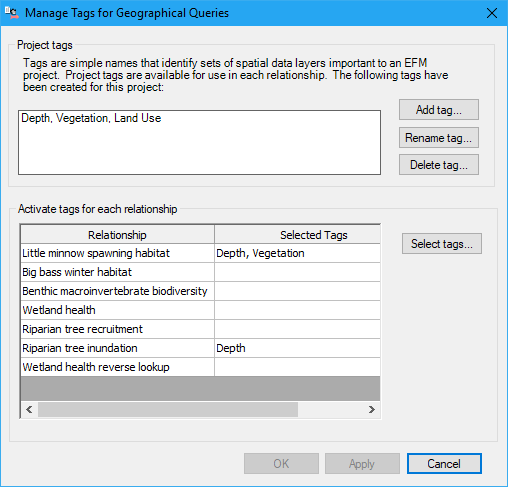
Figure 5. The Manage Tags for Geographical Queries interface in HEC-EFM is used for editing and creating tags, which are labels for sets of spatial data important to an HEC-EFM project.
Other Queries (nonstandard) – Statistical results for a standard HEC-EFM relationship is a pair of flow and stage data that meet the statistical criteria specified for that relationship. Currently, the only nonstandard queries available are Reverse lookup and Ecovalue summation. Reverse lookups do not compute a flow and stage, instead the user specifies a flow and HEC-EFM computes the percent of years or percent of time that flow is equaled or exceeded. Ecovalue summations tally the ecovalues (see sections "Ecovalues and Ecovalue Shift" and "Ecovalue Summations and Summations Shift") provided by different flow regimes. When the Ecovalue summation query is turned on for a relationship, summations are computed in addition to all steps normally performed to assess that relationship. Ecovalue summations can be done for standard or Reverse lookup relationships. The Hypothesis tracking option must be selected to use ecovalue summations.
Options – Three options are available for each relationship: Write computation arrays, Hypothesis tracking, and Confidence tracking. The Write computation arrays option prompts HEC-EFM to export the statistical computations performed for that relationship. Hypothesis tracking allows users to compare the direction of change of eco-health for different flow regimes. The question that hypothesis tracking asks is: "Increased flow will do what to eco-health?" for this relationship. Users have the option of saying that increased flow will help (+), hurt (-), or have a non-linear response (via the Curve button) to eco-health. Confidence tracking provides a way to track the relative certainty of HEC-EFM relationships. The default is one star. This starting point implies that there is the same amount of scientific understanding for each of the relationships. As confidence in a particular relationship grows, its number of stars can be increased at the discretion of the study team, perhaps when the relationship is verified with field data, backed with scientific literature, or approved by a group of scientists or agencies.