Download PDF
Download page Advancing Hydrologic Modeling with Machine Learning Methods: From Parameter Estimation to Forecasting.
Advancing Hydrologic Modeling with Machine Learning Methods: From Parameter Estimation to Forecasting
By: Krishna B. Khatri, Ph.D., P.E., M.ASCE
Introduction
Hydrologic modeling remains a cornerstone of modern water resources management, enabling the simulation and prediction of complex hydrologic and hydraulic processes across watersheds with diverse physiographic and climatic settings. The U.S. Army Corps of Engineers (USACE) continues advancing its water-resources mission through innovation, engineering modernization, and data-informed decision-making. The Hydrologic Engineering Center (HEC) has been established as a leader in hydrologic software development, particularly in flood risk assessment.
The application of Artificial Intelligence (AI) and Machine Learning (ML) in the water sector has expanded rapidly in recent years. The growth is driven by stronger computing power in personal laptops, increasing data availability, rapid improvements in ML algorithms, and accessible open-source tools like TensorFlow and PyTorch, making applications of AI/ML more practical than ever. These advances, along with strong engagement and successful innovations from both academia and the private sector, now create meaningful opportunities to enhance and complement HEC’s existing modeling systems and workflows. AI/ML technologies are proven to be valuable not only for data extraction and assimilation, streamflow prediction, reservoir operations, water-quality assessment, and flood forecasting, but also for reducing the time and cost of forecasting and improving accuracy (GAO, 2023).
Recognizing the ongoing transformation in hydrologic modeling, HEC is carefully evaluating current technologies to integrate into the HEC software suite to enhance hydrologic modeling, strengthen operational readiness, and support risk-informed water-management decisions.
Why AI/ML Matters for HEC
Traditional HEC hydrologic modeling software, such as HEC-HMS, HEC-RAS, HEC-ResSim and HEC-RTS, remain the backbone for simulating hydrologic processes and supporting water-management decisions. However, ML methods are proven to improve computational efficiency, reduce runtime, and enhance predictive performance, particularly in data-rich or rapidly changing environments. Therefore, whether applied as a standalone approach or in a hybrid configuration, ML-based modeling complements traditional methods by significantly improving model predictability and computational efficiency.
The rapid expansion of publicly accessible hydrologic and environmental datasets now provides the scale needed to develop robust, transferable ML frameworks, signaling a broader shift toward dynamic, data-intensive hydrologic modeling. Publicly available and standardized hydrologic datasets such as NLDAS, Daymet, CAMELS (Addor et al., 2017), and CARAVAN (Kratzert et al., 2023) allow researchers to build, train, and test ML-based algorithms across diverse watersheds in the U.S. and much of the world. This means data availability is no longer a major limiting factor for developing and deploying ML-based hydrologic models of any type.
Academic institutions, researchers, and major tech companies are advancing significant innovations in AI/ML across all sectors, including hydrology, by developing new computational tools, standardizing datasets, and creating more efficient algorithms. A rapidly expanding research base, fueled by hundreds of daily publications, now supports ML applications tailored to specific hydrologic and operational needs. Classical algorithms, such as regression and decision trees, are effective for parameter estimation and data transparency, while advanced approaches like neural networks and deep learning excel in handling large-scale, unstructured data (see Figure 1 for a summary of ML models typically used in water resources modeling applications). Emerging trends, including physics-informed ML models, bridge data-driven and process-based methods to improve interpretability and scalability. These technologies address critical challenges in rainfall-runoff modeling, reservoir systems modeling, flood risk assessment, water quality analysis, and database analysis. Readers can find more relevant discussions of current ML-based applications in hydrologic modeling in several publications (e.g., Ghobadi and Kang, 2022; Kratzert et al., 2018; Mai et al., 2022; Nearing et al., 2024; Tripathy and Mishra, 2020; Zhi et al., 2024).

AI/ML applications are no longer just theoretical or purely academic exercises. Private-sector organizations, including engineering consulting firms and the tech industry, are applying AI/ML to real-world problems, demonstrating how these technologies can enhance forecasting, infrastructure analysis, and operational decision support. For example:
- Google’s Flood Hub applies deep learning-based Long Short-Term Memory (LSTM) networks to forecast river flooding up to seven days in advance across 80+ countries (https://sites.research.google/gr/floodforecasting/).
- Stantec uses ML for infrastructure risk analysis, predicting pipe failures, and integrating flood-scenario analytics with HEC-RAS (https://www.stantec.com/en/services/digital).
- Upstream Tech’s HydroForecast employs physics-guided LSTM architectures that aggregate satellite, weather, and basin data to predict streamflow from hourly to seasonal timescales, even in ungauged basins (https://www.upstream.tech/hydroforecast).
These real-world successes show that ML-based modeling can provide faster, more adaptive, and data-driven decision-support capabilities. They underscore the need for USACE to evaluate these benefits and proactively prepare for potential integration into the HEC software suite for future operations.
AI/ML Initiative at HEC: Work Already Underway
Developed an AI/ML Strategic Plan outlining priority applications, integration pathways, and long-term objectives. The plan identifies three primary goals: (1) investigate and integrate AI/ML techniques into HEC software and USACE modeling workflows where they provide clear value, (2) incorporate AI tools into HEC staff’s daily work with an emphasis on software development, and (3) apply AI to enhance how we deliver and transfer technology to our customers. This plan focuses on identifying where AI/ML can improve efficiency, accuracy, and overall effectiveness—not only in hydrologic modeling but also across HEC’s day-to-day operations.
Documented a state-of-the-art literature review of AI/ML research in hydrology, flood risk management, optimization, and operational decision support to identify potential AI/ML algorithms that could be integrated into the HEC software suite (Khatri and Fleming, 2024). This effort also proposed a phased roadmap for integrating AI/ML into HEC’s software suite, outlining short-, medium-, and long-term opportunities. For each phase, specific goals, objectives, and recommended tasks were identified based on insights from the literature and expert input from HEC staff.
Established collaborative pilot studies with academic partners to evaluate ML-based forecasting, hybrid modeling approaches, and benchmarking analyses. A technical team from HEC collaborated with the University of California, Berkeley, to complete an ML-based streamflow prediction study for the Success Dam watershed in the downstream portion of the Tule River, California (Fleming et al., 2024) and applied the NeuralHydrology framework to the managed Russian River basin (Bellugi et al., 2025).
The Tule River watershed study utilized a long record of meteorological data, snow water equivalent (SWE), and reservoir inflows to compare the performance of three modeling approaches: a purely process-based model (HEC-HMS), a data-driven model (LSTM), and a hybrid physics-informed data-driven model (Physics-Informed Long Short-Term Memory - PILSTM) that incorporates HEC-HMS outputs to provide additional physically-based constraints to predict SWE and streamflow into the Schafer Dam reservoir. The result showed that all models performed well for SWE in the base case, but under extreme conditions, the PILSTM showed the best skill in the higher-elevation, snow-dominated basin. In lower-elevation basins with little snow, HEC-HMS performed best, indicating that process-based models may be more robust when phase changes and terrain effects are significant. Inflow prediction remains challenging across all models, but data-driven approaches—especially the PILSTM—generally outperform HEC-HMS, with the PILSTM showing clear advantages in the extreme-climate experiments.
The Russian River study showed that across key performance metrics—including the Nash-Sutcliffe model efficiency component (NSE), Kling-Gupta Efficiency metric (KGE), and flow duration curve statistics—LSTM-based models generally outperformed the process-based HEC-HMS model, though results varied by site and season. The physics-informed LSTM (PILSTM) delivered the strongest overall performance, followed closely by the standalone LSTM, with only a few instances where the standalone model performed slightly better. HEC-HMS occasionally captured peak flows well but more often overestimated them, whereas the LSTM models tended to underestimate high-flow events. For low flows, the LSTM models were generally more reliable, though both modeling approaches exhibited mixed patterns of over- and underestimation under varying hydrologic conditions (see Figure 2). One notable finding from both studies, consistent with results from published comparative analyses, is that deep learning and traditional machine-learning models (e.g., regression, Support Vector Machines, Random Forests) often outperform process-based models in precipitation–runoff prediction.

Completed two in-house ML-application projects: (i) estimating initial state parameters in HEC-HMS to support real-time event calibration, and (ii) developing streamflow prediction models using publicly available data to enhance future real-time decision-making.
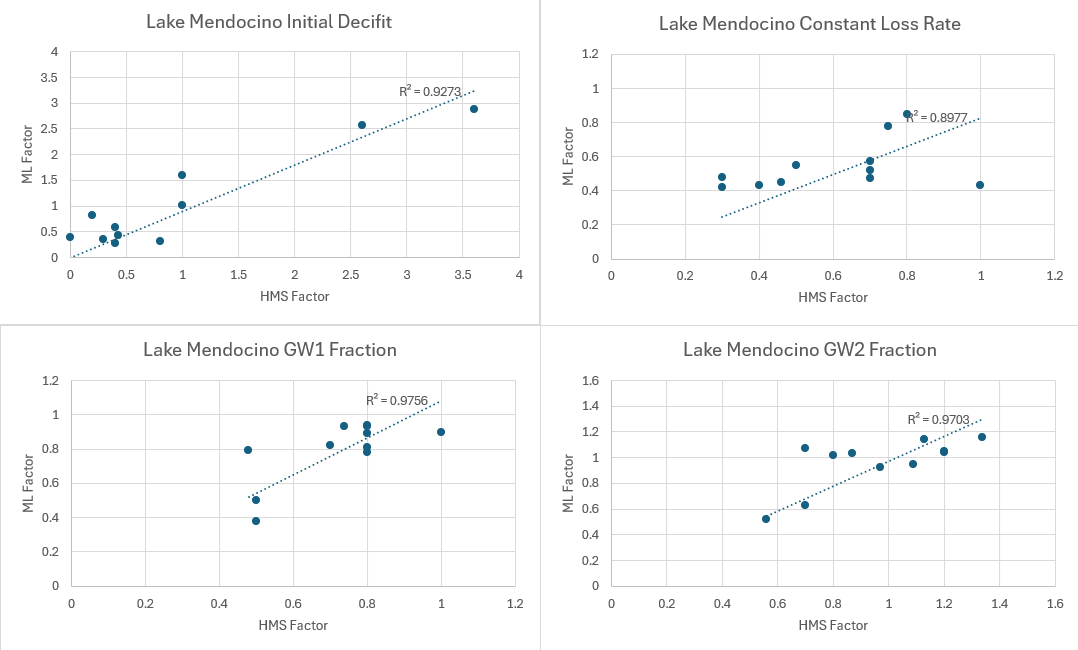
The first study evaluated the applicability of machine-learning techniques reported in recent literature to enhance understanding of hydrologic processes through parameter estimation. In this analysis, the Random Forest algorithm was used to estimate initial parameters that reflect current watershed conditions and reduce the time required for HEC-HMS model calibration. This capability is particularly valuable during flood events, when water managers must rapidly calibrate models and assess multiple scenarios to ensure timely dissemination and communication of results. Figure 3 presents the results of the ML-based parameter estimation applied in one of our case studies. The figure compares model parameters, initial deficit, constant loss rate, and groundwater fraction parameters, from manual calibration to those predicted by a Random Forest model. Predicted parameter values from the Random Forecast model are represented on the Y-axis (i.e., ML Factor) and manually calibrated parameter values are represented on the X-axis (i.e., HMS Factor). Results demonstrate the Random Forest model (which was trained using many calibration events, including the meteorologic information preceding the calibration events) can be used to quickly predict model parameters. The Random Forest-predicted parameters are not perfect, but give the modeler a solid starting point to continue calibration in real-time flood forecasting applications.
The second study aimed to further evaluate the performance of the Multi-Timescale LSTM (MTS-LSTM) model at a large regional scale, in line with a key recommendation from the Russian River watershed streamflow benchmark study (Bellugi et al., 2025) to conduct regional-scale analyses across multiple basins to capture hydrologic variability better.
The study incorporated 133 sub-basins within HUC-2 regions 17 and 18 of the CAMELS dataset, representing the Pacific Northwest and Pacific Coast, respectively, as included in the CAMELS database. The CAMELS dataset provides basin-averaged daily meteorological forcings—including precipitation, temperature, shortwave radiation, and humidity—derived from three gridded data sources (NLDAS, Maurer, and Daymet) for the period 1 January 1980 to 31 December 2014, along with daily streamflow observations from the U.S. Geological Survey (USGS). It also includes a wide range of catchment attributes related to soil, geology, vegetation, and climate.
Additional findings from this study indicate that incorporating static watershed attributes—such as topography and geometry, land cover and vegetation, soil properties, and geology —improved model performance at longer timescales, likely because these characteristics control baseline runoff generation. In contrast, performance at finer temporal resolutions (e.g., hourly) was more strongly driven by dynamic meteorological forcings such as precipitation intensity and temperature. Figure 4 shows model performances for four model alternatives at both the daily and hourly time scales.
These efforts confirm that ML-based models can be developed and executed on a standard office laptop, that ample standardized hydrologic data are readily accessible, and that resulting model performance is both acceptable and operationally meaningful.

AI/ML Opportunities, Challenges, and Path Forward
AI/ML technologies are not a universal solution to all hydrologic challenges, and they are not expected to replace process-based models entirely. However, adoption of AI/ML technologies, whether used in a standalone mode or integrated into the HEC software suite, offer significant benefits, including lower computational costs, improved model accuracy, more efficient data-processing workflows, and reduced time for USACE staff to generate real-time predictions. These capabilities support USACE goals for resilient infrastructure, modern engineering, and data-driven water management operations.
Conversely, integrating AI/ML into HEC’s modeling environment introduces important technical and operational challenges. Key issues include how to capture variability in watersheds, ensure access to adequate computational resources, maintain a trained workforce capable of adopting these technologies, and modeling processes that are transparent, replicable, and explainable. AI/ML algorithms and tools must undergo rigorous validation and verification and demonstrate reliable performance under changing hydrologic and climatic conditions. They also need to generalize well across diverse physiographic and climatic regions before being used in field applications or decision-making processes.
Moving forward, HEC will focus on developing hybrid physics-based ML modeling frameworks, building AI-ready data pipelines, building academic and industry partnerships, and deploying explainable, operationally reliable AI/ML tools. These efforts will advance USACE’s modeling capabilities, prepare for emerging future needs, improve forecast accuracy and operational efficiency, and support stronger water-resource decision-making across USACE. As part of our mission to serve USACE, water managers, and the public, we remain committed to delivering reliable, trustworthy, and easy-to-use tools that meet the evolving needs of the water resources community.
References
Addor, N., Newman, A. J., Mizukami, N., and Clark, M. P. (2017). The CAMELS data set: Catchment attributes and meteorology for large-sample studies. Hydrology and Earth System Sciences, 21(10), 5293–5313. https://doi.org/10.5194/hess-21-5293-2017
Bellugi, D. G., Khatri, K. B. , Ruso, S. C., Sokolovskaya, N.L., Robert, E., Blaylock, M. C. , Larsen, L. G., and Fleming, M. J.(2025). Hydrologic Modeling Using HEC-HMS and Deep Learning Models in Russian River Watershed. U.S. Army Corps of Engineers Reports. https://www.hec.usace.army.mil/confluence/spaces/IIAAIMLT/pages/299502706/References
Fleming, M., Bellugi, D.G., Roberts, E., Sokolovskaya, N., Srivas, S., Larsen, L., and Tennant, C.J. (2024),Hydrologic Modeling using HEC-HMS and Machine Learning Models, U.S. Army Corps of Engineers Reports. https://www.hec.usace.army.mil/confluence/spaces/IIAAIMLT/pages/299502706/References
GAO (United States Government Accountability Office), (2023). Technology assessment: Artificial intelligence in natural hazard modeling: Severe storms, hurricanes, floods, and wildfires (Report No. GAO-24-106213). Report to Congressional Addressees. https://www.gao.gov
Ghobadi, F. and Kang, D. (2023). Application of Machine Learning in Water Resources Management: A Systematic Literature Review. Water, 15, 620. https://doi.org/10.3390/w15040620
Khatri, K.B. (2025). Development and Evaluation of a Deep Learning Model for Regional Rainfall-Runoff Simulation. USACE-HEC confluence page
Khatri, K.B. and Fleming, M. J. (2024). Integrating Artificial Intelligence Technologies into HEC’s Software Suite and Hydrologic Data Analysis. Institute for Water Resources, Hydrologic Engineering Center, Water Management Systems Division, New Horizons Project Study Report. https://www.hec.usace.army.mil/confluence/spaces/IIAAIMLT/pages/299502706/References
Kratzert, F., Klotz, D., Brenner, C., Schulz, K., and Herrnegger, M. (2018). Rainfall–runoff modelling using long short-term memory (LSTM) networks. Hydrology and Earth System Sciences, 22(11), 6005-6022.
Kratzert, F., Nearing, G., Addor, N., … and Schilperoort, B. (2023). Caravan – A global community dataset for large-sample hydrology. Scientific Data, 10, Article 61. https://doi.org/10.1038/s41597-023-01975-w
Mai, J., Shen, H., Tolson, B. A., Gaborit, É., Arsenault, R., Craig, J. R., Fortin, V., Fry, L. M., Gauch, M., and Klotz, D. (2022). The great lakes runoff intercomparison project phase 4: the great lakes (GRIP-GL). Hydrology and Earth System Sciences, 26(13), 3537-3572.
Nearing, G., Cohen, D., Dube, V., Gauch, M., Gilon, O., Harrigan, S., Hassidim, A., Klotz, D., Kratzert, F., and Metzger, A. (2024). Global prediction of extreme floods in ungauged watersheds. nature, 627(8004), 559-563.
Tripathy, K. P., and Mishra, A. K. (2023). Deep learning in hydrology and water resources disciplines: Concepts, methods, applications, and research directions. Journal of Hydrology, 130458.
Zhi, W.; Appling, A.P.; Golden, H.E.; Golden, H.E., Podgorski, J., and Li, L.(2024). Deep learning for water quality. Nat Water, 2, 228–241. https://doi.org/10.1038/s44221-024-00202-z