The Brune Trap Efficiency method is a hydrological modeling approach used to estimate the efficiency with which a reservoir or basin traps sediment or debris flowing into it from upstream areas. It is named after its developer, Albert P. Brune.
In the context of sediment transport and reservoir siltation modeling, the Brune Trap Efficiency method assesses how effectively a reservoir or basin retains sediments of varying sizes. This method considers factors such as the size distribution of incoming sediment, the hydraulic conditions within the reservoir or basin, and the sediment deposition patterns.
The Brune Trap Efficiency method is a useful tool for assessing the sedimentation rates in reservoirs, which is crucial for managing water resources, maintaining reservoir capacity, and planning for sediment removal activities. It helps in understanding how efficiently a reservoir traps sediment, which can have implications for water quality, flood control, and hydropower generation.
An additional trap efficiency method is needed to account for reservoir volume reduction based on the sediment siltation volume. One candidate method is the Brune’s trap efficiency method (Brune, 1953) utilized by Kansas City District. By adding Brune’s trap efficiency method in HEC-HMS, USACE local district offices can easily replace their manual excel spreadsheet to estimate the long-term reservoir siltation with HEC-HMS. Brune (1953) presents a family of curves (Figure 1) that estimates the trapping efficiency based on the ratio of reservoir capacity to mean annual discharge.
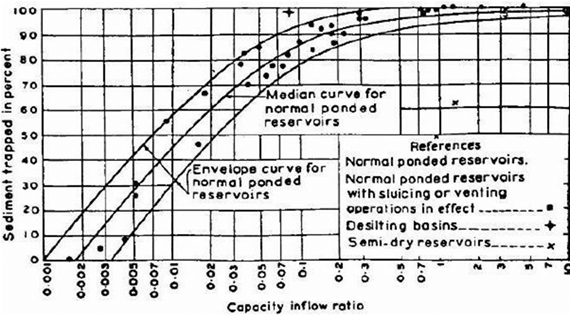
Figure 1. Trap efficiency as related to capacity-inflow ratio, type of reservoir, and method of operation (Brune, 1953)
The following equations can be used to estimate these curves:

a = Constant (recommended range: Minimum :95, Medium: 97, Maximum: 100)
b = Constant (recommended range: Minimum: 5.37, Medium: 6.42, Maximum: 7.71)