Download PDF
Download page Hydraulic Forces.
Hydraulic Forces
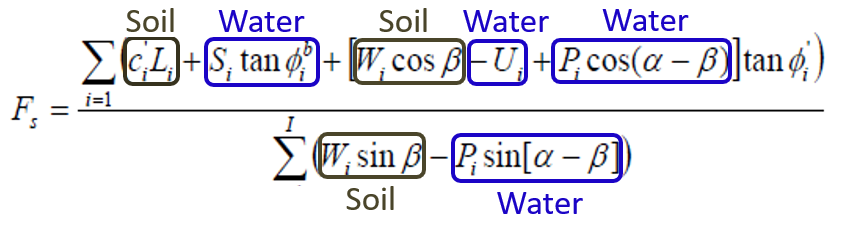
For hydraulic forces there are two terms that consider the weight of the water and two terms that consider the pore water pressure.
Hydrostatic Confining Force
The terms that consider the force of the water in the channel:
Pi cos(α-β) tanΦ'i =The normal component of the hydrostatic confining force of the water in the channel. This is a resisting force because it adds to the normal force acting on the failure plane and, therefore, increases the frictional strength.
Pi cos(α-β) = The component of the hydrostatic confining force acting along the failure plane against the direction of failure. The weight of the soil (the primary driving force) is reduced by this component, where:
α = is the angle between vertical and the vector the hydrostatic force (below) exerted by the channel water (orthogonal to the weighted average of the inundated bank slope) are both resisting forces

Pore Water Pressure
The pore water pressure is divided into two components in the numerator:
-Ui tanΦ'i =Hydrostatic uplift force (buoyancy is a driving force while suction is a resisting force). Water exerts a vertical force on submerged sand grains, reducing the normal force along the failure plane and, therefore, the frictional resistance to failure. Ui is simply the hydrostatic force, which increases linearly with depth below the groundwater table (below). In the saturated zone 'b = φ' so the hydrostatic force is multiplied by tan φ' and can be included in the frictional term of the numerator.
Si tanΦbi =The suction forces increase the soil strength due to the development of negative pore water pressure in the unsaturated zone of the soil which pulls the soil grains together. In the unsaturated zone, as water drains, evaporates, transpires, and is not replaced with atmospheric air, negative pressures (suction) develop.
In general, suction Si is estimated as a continuation of the hydrostatic force into the unsaturated zone. Suction increases with vertical distance above the water table at the same rate that the hydrostatic force increases with vertical distance below the water table. Positive and negative pore water pressures are assumed symmetrical around the water table. This is an idealized assumption, however, that only accounts for gravity draining. Precipitation and infiltration will add water to the unsaturated zone and decrease suction effects and evapo-transpiration will increase negative pore water pressures. If these processes are important, unsaturated pore water pressures will have to be measured (e.g., with a tensiometer).
Translating negative pore water pressures or suction effects into a force in the free body diagram is the most empirical step of computing the factor of safety. Every other parameter can be measured directly or computed. However suction effects are accounted for with an empirical assumption analogous to the friction slope parameter. The suction is translated into "apparent cohesion", (the equivalent amount of cohesion required to produce the same resisting force as the soil suction). Apparent cohesion (shown below) is easily included in the force balance, but is not a physical parameter that can be measured and is very difficult to compute. The angle Φb is simply the linear relationship between the matrix suction measured or computed and the corresponding equivalent cohesion force it represents. This angle can be computed but is heavily labor and data intensive to measure so it is often selected based on user judgment. For most materials Φb is generally between ten to thirty degrees depending on soil type. Most applications use a base Φb between ten and fifteen, but it goes to a maximum of the friction angle when the material is saturated (Fredlund, 1986). Since it is one of the least certain parameters it is often considered a calibration parameter.
If the water surface in the channel is close to the groundwater elevation the confining forces of the water in the channel offset most of the driving force of the interstitial water. However, if the water in the channel is substantially lower than the soil water elevation (e.g., in the case of a rapid channel drawdown in poorly drained soils, leaving a perched groundwater table), the confining forces of the water will be removed while the driving forces (the weight of the water and the buoyant reduction in soil friction) remain. This is why the critical failure condition is often a case of substantial differential between ground water and surface water elevations. 