The Fragility Curve Plugin allows the user to define fragility curves (sometimes called system performance curves) and randomly sample failure elevations for use in a HEC-WAT Flood Risk Analysis (FRA) compute. A fragility curve represents the probability of failure leading to a breach of the structure for a range of water surface elevation values for a specific structure.  The sampled elevation of failure is passed as a data location that can be linked to subsequent models in the HEC-WAT simulation, such as HEC-RAS and HEC-ResSim.  The structure and the sampled elevation may have different meanings depending on the configuration of this model, most often applied to the HEC-RAS as a levee or dam breach elevation, where the river-side of a levee, or upstream side must exceed the elevation for the structure to breach.  Other models, such as HEC-ResSim require additional user-defined behavior to properly model the system's response when the failure elevation is exceeded.  Fragility curves can be resampled for every event, or once every realization, depending if the failure mode should be represented as natural variability or knowledge uncertainty.  Fragility curves may also include a loading duration, and sample from multiple failure modes for each structure.

Fragility Curves

A fragility curve could be used by a dam or a levee depending on the consuming model.  HEC-RAS models can use the output of the fragility curve at inline structures (usually dams) or lateral structures (usually levees).  HEC-ResSim can ingest the failure elevation as a scalar Global Variable but the user must set up logic to handle the resulting system behavior correctly.

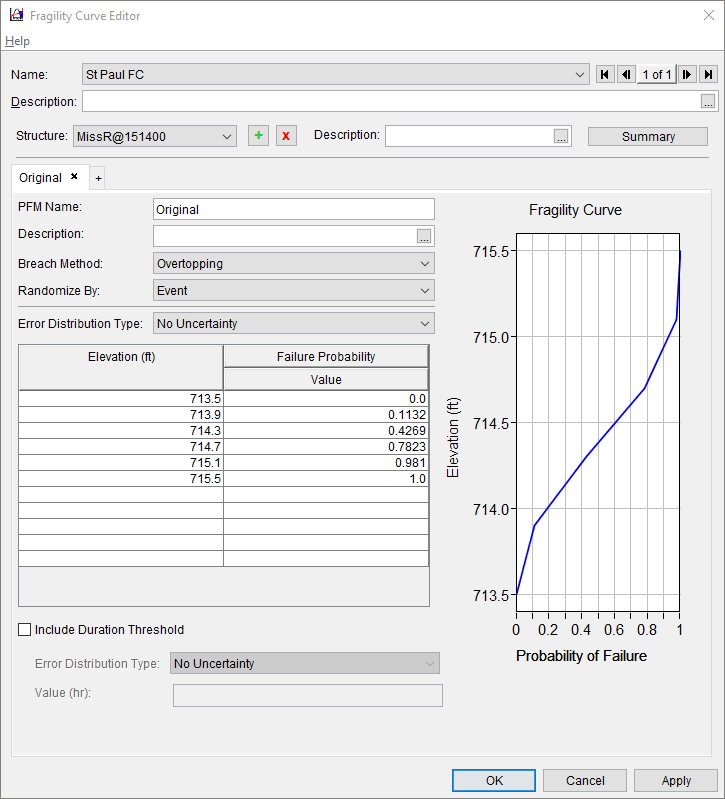
Fragility Curve Editor