Table of Contents
Target Namespace
None
Element and Attribute Namespaces
Global element and attribute declarations belong to this schema's target namespace.
By default, local element declarations have no namespace.
By default, local attribute declarations have no namespace.
Schema Composition
This schema imports schema(s) from the following namespace(s):
Declared Namespaces
Prefix
Namespace
xml
http://www.w3.org/XML/1998/namespace
xs
http://www.w3.org/2001/XMLSchema
dt
http://www.hec.usace.army.mil/xmlSchema/cwms/hec-datatypes
Schema Component Representation
<
xs:schema elementFormDefault ="
unqualified ">
<xs:import namespace ="http://www.hec.usace.army.mil/xmlSchema/cwms/hec-datatypes " schemaLocation ="hec-datatypes.xsd "/>
...
</
xs:schema >
This element can be used wherever the following element is referenced:
Name
rating
Type
anyType
Nillable
no
Abstract
no
Documentation
An alias for simple-rating.
Diagram
Name
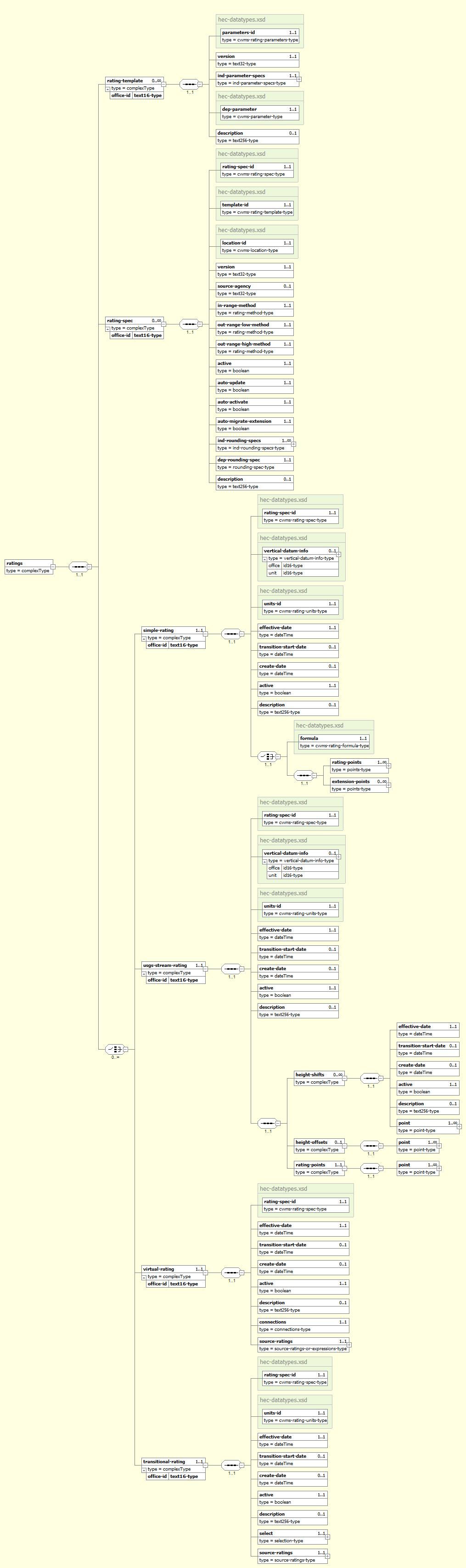
ratings
Type
Locally-defined complex type
Nillable
no
Abstract
no
Documentation
A collection of rating templates, rating specifications, and ratings of various types.
Diagram
XML Instance Representation
<ratings>
Start Choice [0..*] End Choice </ratings>
Schema Component Representation
<
xs:element name ="
ratings ">
<
xs:complexType >
<
xs:sequence >
<
xs:element ref ="
rating-spec "
minOccurs ="
0 "
maxOccurs ="
unbounded "/>
<
xs:choice minOccurs ="
0 "
maxOccurs ="
unbounded ">
</
xs:choice >
</
xs:sequence >
</
xs:complexType >
</
xs:element >
Name
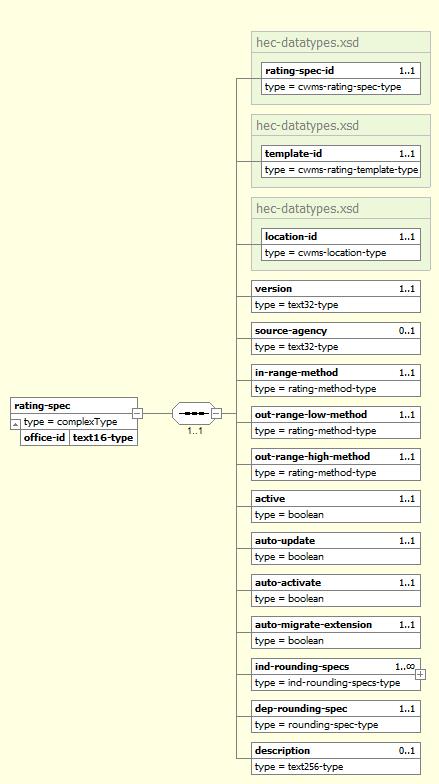
rating-spec
Type
Locally-defined complex type
Nillable
no
Abstract
no
Documentation
A named collection of location, rating template, temporal lookup behaviors,
update settings, and rounding specifications.
Diagram
XML Instance Representation
<rating-spec
office-id="text16-type [1] " >
<auto-update>
boolean </auto-update>
[1] <auto-activate>
boolean </auto-activate>
[1] <auto-migrate-extension>
boolean </auto-migrate-extension>
[1] </rating-spec>
Schema Component Representation
<
xs:element name ="
rating-spec ">
<
xs:complexType >
<
xs:sequence >
<
xs:element name ="
source-agency "
type ="
text32-type "
minOccurs ="
0 "/>
<
xs:element name ="
active "
type ="
boolean "/>
<
xs:element name ="
auto-update "
type ="
boolean "/>
<
xs:element name ="
auto-activate "
type ="
boolean "/>
<
xs:element name ="
auto-migrate-extension "
type ="
boolean "/>
<
xs:element name ="
description "
type ="
text256-type "
minOccurs ="
0 "/>
</
xs:sequence >
<
xs:attribute name ="
office-id "
type ="
text16-type "
use ="
required "/>
</
xs:complexType >
</
xs:element >
Name
rating-template
Type
Locally-defined complex type
Nillable
no
Abstract
no
Documentation
A named collection of rating parameters and lookup behaviors.
Diagram
XML Instance Representation
<rating-template
office-id="text16-type [1] " >
</rating-template>
Schema Component Representation
<
xs:element name ="
rating-template ">
<
xs:complexType >
<
xs:sequence >
<
xs:element name ="
description "
type ="
text256-type "
minOccurs ="
0 "/>
</
xs:sequence >
<
xs:attribute name ="
office-id "
type ="
text16-type "
use ="
required "/>
</
xs:complexType >
</
xs:element >
The following elements can be used wherever this element is referenced:
Name
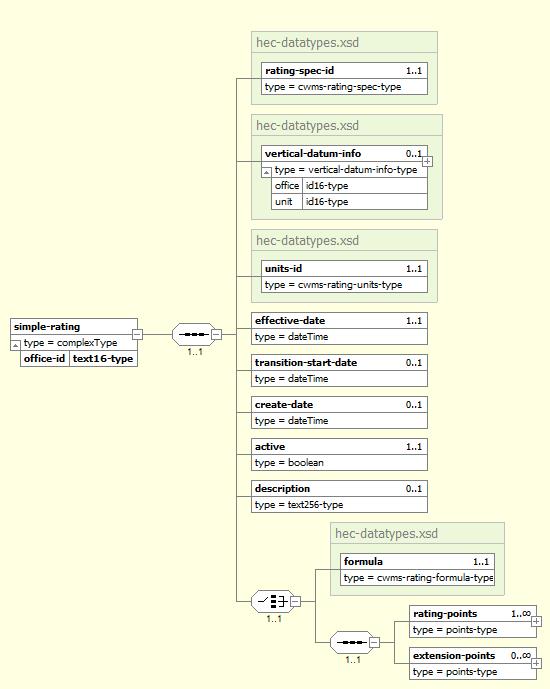
simple-rating
Type
Locally-defined complex type
Nillable
no
Abstract
no
Documentation
A dated rating consisting of a single lookup table or a single formula with specified parameter units.
Diagram
XML Instance Representation
<simple-rating
office-id="text16-type [1] " >
<effective-date>
dateTime </effective-date>
[1] <transition-start-date>
dateTime </transition-start-date>
[0..1] <create-date>
dateTime </create-date>
[0..1] Start Choice [1] <extension-points>
points-type </extension-points>
[0..*] End Choice </simple-rating>
Schema Component Representation
<
xs:element name ="
simple-rating ">
<
xs:complexType >
<
xs:sequence >
<
xs:element name ="
effective-date "
type ="
dateTime "/>
<
xs:element name ="
transition-start-date "
type ="
dateTime "
minOccurs ="
0 "/>
<
xs:element name ="
create-date "
type ="
dateTime "
minOccurs ="
0 "/>
<
xs:element name ="
active "
type ="
boolean "/>
<
xs:element name ="
description "
type ="
text256-type "
minOccurs ="
0 "/>
<
xs:choice >
<
xs:sequence >
<
xs:element name ="
rating-points "
type ="
points-type "
maxOccurs ="
unbounded "/>
<
xs:element name ="
extension-points "
type ="
points-type "
minOccurs ="
0 "
maxOccurs ="
unbounded "/>
</
xs:sequence >
</
xs:choice >
</
xs:sequence >
<
xs:attribute name ="
office-id "
type ="
text16-type "
use ="
required "/>
</
xs:complexType >
</
xs:element >
Name
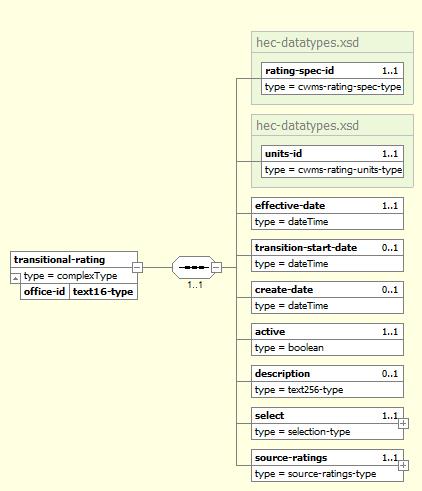
transitional-rating
Type
Locally-defined complex type
Nillable
no
Abstract
no
Documentation
A rating created by specifying which (or which combination) of existing ratings with
identical parameters-ids are used based on values of the input parameters.
Diagram
XML Instance Representation
<transitional-rating
office-id="text16-type [1] " >
<effective-date>
dateTime </effective-date>
[1] <transition-start-date>
dateTime </transition-start-date>
[0..1] <create-date>
dateTime </create-date>
[0..1] </transitional-rating>
Schema Component Representation
<
xs:element name ="
transitional-rating ">
<
xs:complexType >
<
xs:sequence >
<
xs:element name ="
effective-date "
type ="
dateTime "/>
<
xs:element name ="
transition-start-date "
type ="
dateTime "
minOccurs ="
0 "/>
<
xs:element name ="
create-date "
type ="
dateTime "
minOccurs ="
0 "/>
<
xs:element name ="
active "
type ="
boolean "/>
<
xs:element name ="
description "
type ="
text256-type "
minOccurs ="
0 "/>
</
xs:sequence >
<
xs:attribute name ="
office-id "
type ="
text16-type "
use ="
required "/>
</
xs:complexType >
</
xs:element >
Name
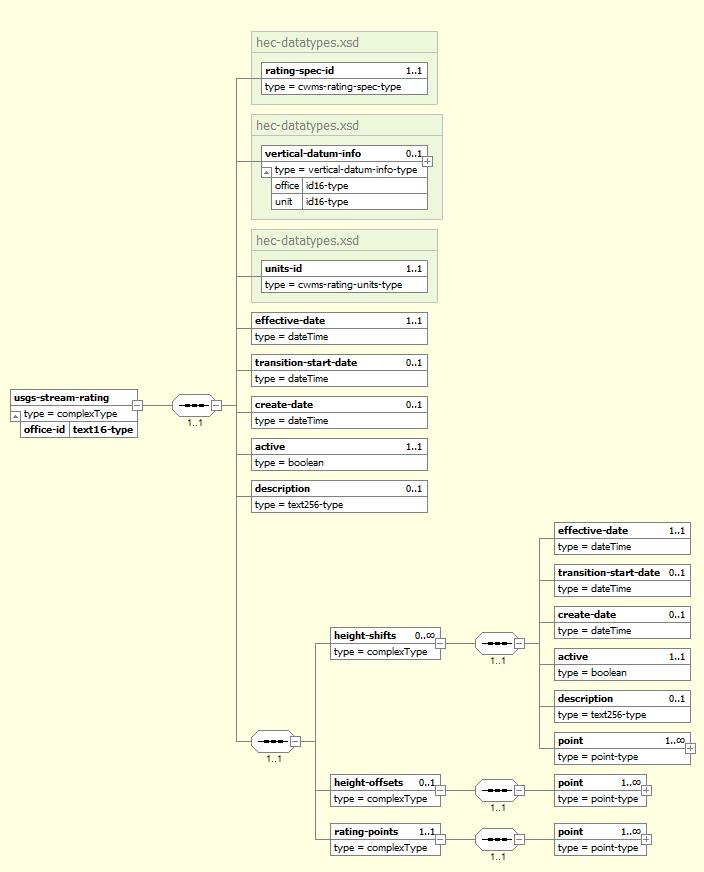
usgs-stream-rating
Type
Locally-defined complex type
Nillable
no
Abstract
no
Diagram
XML Instance Representation
<usgs-stream-rating
office-id="text16-type [1] " >
<effective-date>
dateTime </effective-date>
[1] <transition-start-date>
dateTime </transition-start-date>
[0..1] <create-date>
dateTime </create-date>
[0..1] <height-shifts>
[0..*] <effective-date>
dateTime </effective-date>
[1] <transition-start-date>
dateTime </transition-start-date>
[0..1] <create-date>
dateTime </create-date>
[0..1] </height-shifts>
<height-offsets>
[0..1] </height-offsets>
<rating-points>
[1] </rating-points>
</usgs-stream-rating>
Schema Component Representation
<
xs:element name ="
usgs-stream-rating ">
<
xs:complexType >
<
xs:sequence >
<
xs:element name ="
effective-date "
type ="
dateTime "/>
<
xs:element name ="
transition-start-date "
type ="
dateTime "
minOccurs ="
0 "/>
<
xs:element name ="
create-date "
type ="
dateTime "
minOccurs ="
0 "/>
<
xs:element name ="
active "
type ="
boolean "/>
<
xs:element name ="
description "
type ="
text256-type "
minOccurs ="
0 "/>
<
xs:sequence >
<
xs:element name ="
height-shifts "
minOccurs ="
0 "
maxOccurs ="
unbounded ">
<
xs:complexType >
<
xs:sequence >
<
xs:element name ="
effective-date "
type ="
dateTime "/>
<
xs:element name ="
transition-start-date "
type ="
dateTime "
minOccurs ="
0 "/>
<
xs:element name ="
create-date "
type ="
dateTime "
minOccurs ="
0 "/>
<
xs:element name ="
active "
type ="
boolean "/>
<
xs:element name ="
description "
type ="
text256-type "
minOccurs ="
0 "/>
<
xs:element name ="
point "
type ="
point-type "
maxOccurs ="
unbounded "/>
</
xs:sequence >
</
xs:complexType >
</
xs:element >
<
xs:element name ="
height-offsets "
minOccurs ="
0 ">
<
xs:complexType >
<
xs:sequence >
<
xs:element name ="
point "
type ="
point-type "
maxOccurs ="
unbounded "/>
</
xs:sequence >
</
xs:complexType >
</
xs:element >
<
xs:element name ="
rating-points ">
<
xs:complexType >
<
xs:sequence >
<
xs:element name ="
point "
type ="
point-type "
maxOccurs ="
unbounded "/>
</
xs:sequence >
</
xs:complexType >
</
xs:element >
</
xs:sequence >
</
xs:sequence >
<
xs:attribute name ="
office-id "
type ="
text16-type "
use ="
required "/>
</
xs:complexType >
</
xs:element >
Name
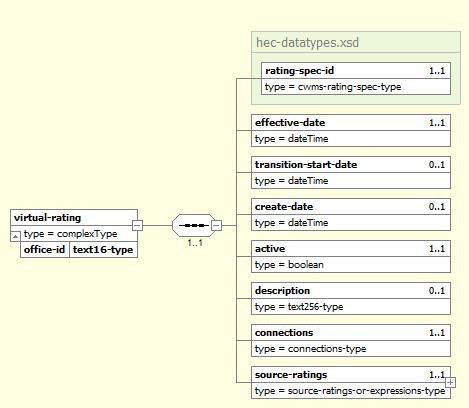
virtual-rating
Type
Locally-defined complex type
Nillable
no
Abstract
no
Documentation
A rating created by connecting inputs and outputs of two or more existing ratings to
form a rating with a new parameters-id.
Diagram
XML Instance Representation
<virtual-rating
office-id="text16-type [1] " >
<effective-date>
dateTime </effective-date>
[1] <transition-start-date>
dateTime </transition-start-date>
[0..1] <create-date>
dateTime </create-date>
[0..1] </virtual-rating>
Schema Component Representation
<
xs:element name ="
virtual-rating ">
<
xs:complexType >
<
xs:sequence >
<
xs:element name ="
effective-date "
type ="
dateTime "/>
<
xs:element name ="
transition-start-date "
type ="
dateTime "
minOccurs ="
0 "/>
<
xs:element name ="
create-date "
type ="
dateTime "
minOccurs ="
0 "/>
<
xs:element name ="
active "
type ="
boolean "/>
<
xs:element name ="
description "
type ="
text256-type "
minOccurs ="
0 "/>
</
xs:sequence >
<
xs:attribute name ="
office-id "
type ="
text16-type "
use ="
required "/>
</
xs:complexType >
</
xs:element >
Super-types:
None
Sub-types:
None
Name
ind-parameter-specs-type
Abstract
no
Diagram
Schema Component Representation
<
xs:complexType name ="
ind-parameter-specs-type ">
<
xs:sequence >
</
xs:sequence >
</
xs:complexType >
Super-types:
None
Sub-types:
None
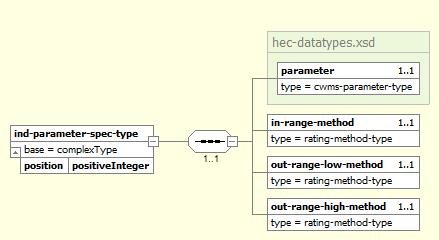
Name
ind-parameter-spec-type
Abstract
no
Diagram
XML Instance Representation
<...
position="xs :positiveInteger[1] " >
</...>
Schema Component Representation
<
xs:complexType name ="
ind-parameter-spec-type ">
<
xs:sequence >
</
xs:sequence >
<
xs:attribute name ="
position "
type ="
xs :positiveInteger"
use ="
required "/>
</
xs:complexType >
Super-types:
None
Sub-types:
None
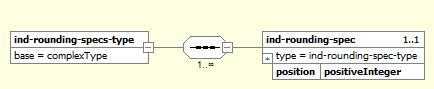
Name
ind-rounding-specs-type
Abstract
no
Diagram
XML Instance Representation
<...>
Start Sequence [1..*] End Sequence </...>
Schema Component Representation
<
xs:complexType name ="
ind-rounding-specs-type ">
<
xs:sequence maxOccurs ="
unbounded ">
</
xs:sequence >
</
xs:complexType >
Super-types:
xs :string <
rounding-spec-type
(by restriction) < ind-rounding-spec-type (by extension)
Sub-types:
None
Name
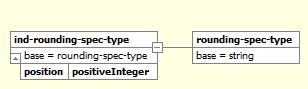
ind-rounding-spec-type
Abstract
no
Diagram
Schema Component Representation
<
xs:complexType name ="
ind-rounding-spec-type ">
<
xs:simpleContent >
<
xs:extension base ="
rounding-spec-type ">
<
xs:attribute name ="
position "
type ="
xs :positiveInteger"
use ="
required "/>
</
xs:extension >
</
xs:simpleContent >
</
xs:complexType >
Super-types:
None
Sub-types:
None
Name
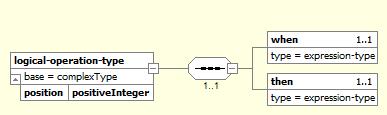
logical-operation-type
Abstract
no
Diagram
XML Instance Representation
<...
position="xs :positiveInteger[1] " >
</...>
Schema Component Representation
<
xs:complexType name ="
logical-operation-type ">
<
xs:sequence >
</
xs:sequence >
<
xs:attribute name ="
position "
type ="
xs :positiveInteger"
use ="
required "/>
</
xs:complexType >
Super-types:
None
Sub-types:
None
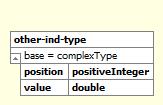
XML Instance Representation
<...
position="xs :positiveInteger[1] " value="double [1] " />
Schema Component Representation
<
xs:complexType name ="
other-ind-type ">
<
xs:attribute name ="
position "
type ="
xs :positiveInteger"
use ="
required "/>
<
xs:attribute name ="
value "
type ="
double "
use ="
required "/>
</
xs:complexType >
Super-types:
None
Sub-types:
None
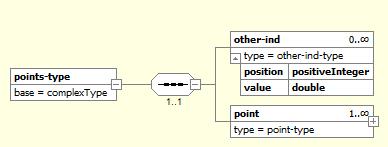
Schema Component Representation
<
xs:complexType name ="
points-type ">
<
xs:sequence >
<
xs:element name ="
other-ind "
type ="
other-ind-type "
minOccurs ="
0 "
maxOccurs ="
unbounded "/>
<
xs:element name ="
point "
type ="
point-type "
maxOccurs ="
unbounded "/>
</
xs:sequence >
</
xs:complexType >
Super-types:
None
Sub-types:
None
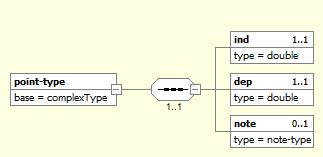
Schema Component Representation
<
xs:complexType name ="
point-type ">
<
xs:sequence >
<
xs:element name ="
ind "
type ="
double "/>
<
xs:element name ="
dep "
type ="
double "/>
<
xs:element name ="
note "
type ="
note-type "
minOccurs ="
0 "/>
</
xs:sequence >
</
xs:complexType >
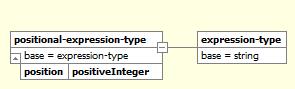
Super-types:
xs :string <
expression-type
(by restriction) < positional-expression-type (by extension)
Sub-types:
None
Name
positional-expression-type
Abstract
no
Diagram
Schema Component Representation
<
xs:complexType name ="
positional-expression-type ">
<
xs:simpleContent >
<
xs:extension base ="
expression-type ">
<
xs:attribute name ="
position "
type ="
xs :positiveInteger"
use ="
required "/>
</
xs:extension >
</
xs:simpleContent >
</
xs:complexType >
Super-types:
None
Sub-types:
None
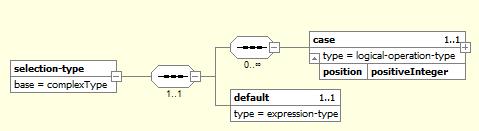
XML Instance Representation
<...>
Start Sequence [0..*] End Sequence </...>
Schema Component Representation
<
xs:complexType name ="
selection-type ">
<
xs:sequence >
<
xs:sequence minOccurs ="
0 "
maxOccurs ="
unbounded ">
</
xs:sequence >
</
xs:sequence >
</
xs:complexType >
Super-types:
None
Sub-types:
None
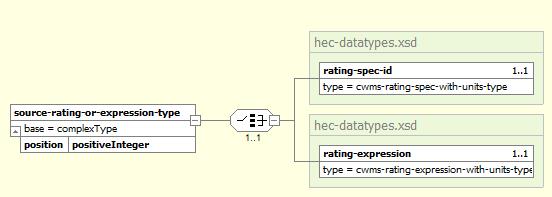
Name
source-rating-or-expression-type
Abstract
no
Diagram
XML Instance Representation
<...
position="xs :positiveInteger[1] " >
Start Choice [1] End Choice </...>
Schema Component Representation
<
xs:complexType name ="
source-rating-or-expression-type ">
<
xs:attribute name ="
position "
type ="
xs :positiveInteger"
use ="
required "/>
</
xs:complexType >
Super-types:
None
Sub-types:
None
Name
source-ratings-or-expressions-type
Abstract
no
Diagram
XML Instance Representation
<...>
Start Sequence [1..*] End Sequence </...>
Schema Component Representation
<
xs:complexType name ="
source-ratings-or-expressions-type ">
<
xs:sequence maxOccurs ="
unbounded ">
</
xs:sequence >
</
xs:complexType >
Super-types:
None
Sub-types:
None
Name
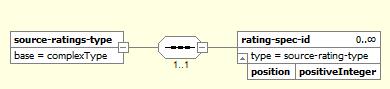
source-ratings-type
Abstract
no
Diagram
Schema Component Representation
<
xs:complexType name ="
source-ratings-type ">
<
xs:sequence >
<
xs:element name ="
rating-spec-id "
type ="
source-rating-type "
minOccurs ="
0 "
maxOccurs ="
unbounded "/>
</
xs:sequence >
</
xs:complexType >
Name
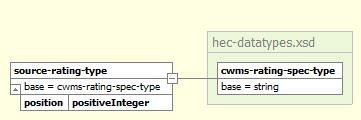
source-rating-type
Abstract
no
Diagram
Schema Component Representation
<
xs:complexType name ="
source-rating-type ">
<
xs:simpleContent >
<
xs:extension base ="
dt :cwms-rating-spec-type ">
<
xs:attribute name ="
position "
type ="
xs :positiveInteger"
use ="
required "/>
</
xs:extension >
</
xs:simpleContent >
</
xs:complexType >
Super-types:
xs :string < boolean (by restriction)
Sub-types:
None
Name
boolean
Content
pattern = ?(true|false) ?
Schema Component Representation
<
xs:simpleType name ="
boolean ">
<
xs:restriction base ="
xs :string">
<xs:pattern value ="?(true|false) ? "/>
<xs:whiteSpace value ="collapse "/>
</
xs:restriction >
</
xs:simpleType >
Super-types:
xs :string < connections-type (by restriction)
Sub-types:
None
Name
connections-type
Content
pattern = [Rr]\d([Dd]|[Ii]\d)=([Rr]\d([Dd]|[Ii]\d)|[Ii]\d)(,[Rr]\d([Dd]|[Ii]\d)=([Rr]\d([Dd]|[Ii]\d)|[Ii]\d))*
Schema Component Representation
<
xs:simpleType name ="
connections-type ">
<
xs:restriction base ="
xs :string">
<xs:pattern value ="[Rr]\d([Dd]|[Ii]\d)=([Rr]\d([Dd]|[Ii]\d)|[Ii]\d)(,[Rr]\d([Dd]|[Ii]\d)=([Rr]\d([Dd]|[Ii]\d)|[Ii]\d))* "/>
<xs:whiteSpace value ="collapse "/>
</
xs:restriction >
</
xs:simpleType >
Super-types:
xs :string < dateTime (by restriction)
Sub-types:
None
Name
dateTime
Content
pattern = ?-?[0-9]{4}-[0-9]{2}-[0-9]{2}T[0-9]{2}:[0-9]{2}:[0-9]{2}([.][0-9]+)?(Z|([+]|-)[0-9]{2}:[0-9]{2})? ?
Schema Component Representation
<
xs:simpleType name ="
dateTime ">
<
xs:restriction base ="
xs :string">
<xs:pattern value ="?-?[0-9]{4}-[0-9]{2}-[0-9]{2}T[0-9]{2}:[0-9]{2}:[0-9]{2}([.][0-9]+)?(Z|([+]|-)[0-9]{2}:[0-9]{2})? ? "/>
<xs:whiteSpace value ="collapse "/>
</
xs:restriction >
</
xs:simpleType >
Simple Type: double
Super-types:
xs :string < double (by restriction)
Sub-types:
None
Name
double
Content
pattern = ?(-?[0-9]*[.]?[0-9]*([Ee]-?[0-9]+)?|NaN|INF) ?
Schema Component Representation
<
xs:simpleType name ="
double ">
<
xs:restriction base ="
xs :string">
<xs:pattern value ="?(-?[0-9]*[.]?[0-9]*([Ee]-?[0-9]+)?|NaN|INF) ? "/>
<xs:whiteSpace value ="collapse "/>
</
xs:restriction >
</
xs:simpleType >
Super-types:
xs :string < expression-type (by restriction)
Sub-types:
Name
expression-type
Content
Schema Component Representation
<
xs:simpleType name ="
expression-type ">
<
xs:restriction base ="
xs :string">
<xs:maxLength value ="256 "/>
<xs:whiteSpace value ="collapse "/>
</
xs:restriction >
</
xs:simpleType >
Super-types:
xs :string < note-type (by restriction)
Sub-types:
None
Schema Component Representation
<
xs:simpleType name ="
note-type ">
<
xs:restriction base ="
xs :string">
<xs:maxLength value ="16 "/>
</
xs:restriction >
</
xs:simpleType >
Super-types:
xs :string < rating-method-type (by restriction)
Sub-types:
None
Name
rating-method-type
Content
pattern = [Nn][Uu][Ll][Ll]|[Ee][Rr][Rr][Oo][Rr]|[Ll][Ii][Nn][Ee][Aa][Rr]|[Ll][Oo][Gg][Aa][Rr][Ii][Tt][Hh][Mm][Ii][Cc]|[Ll][Ii][Nn]-[Ll][Oo][Gg]|[Ll][Oo][Gg]-[Ll][Ii][Nn]|[Pp][Rr][Ee][Vv][Ii][Oo][Uu][Ss]|[Nn][Ee][Xx][Tt]|[Nn][Ee][Aa][Rr][Ee][Ss][Tt]|[Ll][Oo][Ww][Ee][Rr]|[Hh][Ii][Gg][Hh][Ee][Rr]|[Cc][Ll][Oo][Ss][Ee][Ss][Tt]
Schema Component Representation
<
xs:simpleType name ="
rating-method-type ">
<
xs:restriction base ="
xs :string">
<xs:pattern value ="[Nn][Uu][Ll][Ll]|[Ee][Rr][Rr][Oo][Rr]|[Ll][Ii][Nn][Ee][Aa][Rr]|[Ll][Oo][Gg][Aa][Rr][Ii][Tt][Hh][Mm][Ii][Cc]|[Ll][Ii][Nn]-[Ll][Oo][Gg]|[Ll][Oo][Gg]-[Ll][Ii][Nn]|[Pp][Rr][Ee][Vv][Ii][Oo][Uu][Ss]|[Nn][Ee][Xx][Tt]|[Nn][Ee][Aa][Rr][Ee][Ss][Tt]|[Ll][Oo][Ww][Ee][Rr]|[Hh][Ii][Gg][Hh][Ee][Rr]|[Cc][Ll][Oo][Ss][Ee][Ss][Tt] "/>
<xs:whiteSpace value ="collapse "/>
</
xs:restriction >
</
xs:simpleType >
Super-types:
xs :string < rounding-spec-type (by restriction)
Sub-types:
Name
rounding-spec-type
Content
Schema Component Representation
<
xs:simpleType name ="
rounding-spec-type ">
<
xs:restriction base ="
xs :string">
<xs:pattern value ="?[0-9]{10} ? "/>
<xs:whiteSpace value ="collapse "/>
</
xs:restriction >
</
xs:simpleType >
Super-types:
xs :string < text16-type (by restriction)
Sub-types:
None
Schema Component Representation
<
xs:simpleType name ="
text16-type ">
<
xs:restriction base ="
xs :string">
<xs:maxLength value ="16 "/>
<xs:whiteSpace value ="collapse "/>
</
xs:restriction >
</
xs:simpleType >
Super-types:
xs :string < text256-type (by restriction)
Sub-types:
None
Name
text256-type
Content
Schema Component Representation
<
xs:simpleType name ="
text256-type ">
<
xs:restriction base ="
xs :string">
<xs:maxLength value ="256 "/>
<xs:whiteSpace value ="collapse "/>
</
xs:restriction >
</
xs:simpleType >
Super-types:
xs :string < text32-type (by restriction)
Sub-types:
None
Schema Component Representation
<
xs:simpleType name ="
text32-type ">
<
xs:restriction base ="
xs :string">
<xs:maxLength value ="32 "/>
<xs:whiteSpace value ="collapse "/>
</
xs:restriction >
</
xs:simpleType >
Complex Type:
Schema Component Type
AusAddress Schema Component Name
Super-types:
Address < AusAddress (by extension)
Sub-types:
QLDAddress (by restriction)
If this schema component is a type definition, its type hierarchy is shown in a gray-bordered box.
The table above displays the properties of this schema component.
XML Instance Representation
<...
country="Australia "
>
<unitNo> string </unitNo> [0..1]
<houseNo> string </houseNo> [1]
<street> string </street> [1]
Start Choice
[1]
<city> string </city> [1]
<town> string </town> [1]
End Choice
<state> AusStates </state> [1] <postcode> string <<pattern = [1-9][0-9]{3}>> </postcode> [1]
?
</...>
The XML Instance Representation table above shows the schema component's content as an XML instance.
The minimum and maximum occurrence of elements and attributes are provided in square brackets, e.g. [0..1].
Model group information are shown in gray, e.g. Start Choice ... End Choice.
For type derivations, the elements and attributes that have been added to or changed from the base type's content are shown in bold .
If an element/attribute has a fixed value, the fixed value is shown in green, e.g. country="Australia".
Otherwise, the type of the element/attribute is displayed.
If the element/attribute's type is in the schema, a link is provided to it.
For local simple type definitions, the constraints are displayed in angle brackets, e.g. <<pattern = [1-9][0-9]{3}>>.
If a local element/attribute has documentation, it will be displayed in a window that pops up when the question mark inside the attribute or next to the element is clicked, e.g. <postcode>.
Schema Component Representation
<complexType
name ="AusAddress "> <complexContent > <extension
base ="Address <sequence > <element
name ="state " type ="AusStates <element
name ="postcode "> <simpleType > <restriction
base ="string <pattern
value ="[1-9][0-9]{3} "/> </restriction > </simpleType > </element > </sequence > <attribute
name ="country " type ="string fixed ="Australia "/> </extension > </complexContent > </complexType >
The Schema Component Representation table above displays the underlying XML representation of the schema component. (Annotations are not shown.)
Abstract (Applies to complex type definitions and element declarations). An abstract element or complex type cannot used to validate an element instance. If there is a reference to an abstract element, only element declarations that can substitute the abstract element can be used to validate the instance. For references to abstract type definitions, only derived types can be used.
All Model Group Child elements can be provided in any order in instances. See: http://www.w3.org/TR/xmlschema-1/#element-all .
Choice Model Group
Only one from the list of child elements and model groups can be provided in instances. See: http://www.w3.org/TR/xmlschema-1/#element-choice .
Collapse Whitespace Policy Replace tab, line feed, and carriage return characters with space character (Unicode character 32). Then, collapse contiguous sequences of space characters into single space character, and remove leading and trailing space characters.
Disallowed Substitutions (Applies to element declarations). If substitution is specified, then substitution group members cannot be used in place of the given element declaration to validate element instances. If derivation methods , e.g. extension, restriction, are specified, then the given element declaration will not validate element instances that have types derived from the element declaration's type using the specified derivation methods. Normally, element instances can override their declaration's type by specifying an xsi:type attribute.
Key Constraint Like Uniqueness Constraint , but additionally requires that the specified value(s) must be provided. See: http://www.w3.org/TR/xmlschema-1/#cIdentity-constraint_Definitions .
Key Reference Constraint Ensures that the specified value(s) must match value(s) from a Key Constraint or Uniqueness Constraint . See: http://www.w3.org/TR/xmlschema-1/#cIdentity-constraint_Definitions .
Model Group Groups together element content, specifying the order in which the element content can occur and the number of times the group of element content may be repeated. See: http://www.w3.org/TR/xmlschema-1/#Model_Groups .
Nillable (Applies to element declarations). If an element declaration is nillable, instances can use the xsi:nil attribute. The xsi:nil attribute is the boolean attribute, nil , from the http://www.w3.org/2001/XMLSchema-instance namespace. If an element instance has an xsi:nil attribute set to true, it can be left empty, even though its element declaration may have required content.
Notation A notation is used to identify the format of a piece of data. Values of elements and attributes that are of type, NOTATION, must come from the names of declared notations. See: http://www.w3.org/TR/xmlschema-1/#cNotation_Declarations .
Preserve Whitespace Policy Preserve whitespaces exactly as they appear in instances.
Prohibited Derivations (Applies to type definitions). Derivation methods that cannot be used to create sub-types from a given type definition.
Prohibited Substitutions (Applies to complex type definitions). Prevents sub-types that have been derived using the specified derivation methods from validating element instances in place of the given type definition.
Replace Whitespace Policy Replace tab, line feed, and carriage return characters with space character (Unicode character 32).
Sequence Model Group Child elements and model groups must be provided in the specified order in instances. See: http://www.w3.org/TR/xmlschema-1/#element-sequence .
Substitution Group Elements that are members of a substitution group can be used wherever the head element of the substitution group is referenced.
Substitution Group Exclusions (Applies to element declarations). Prohibits element declarations from nominating themselves as being able to substitute a given element declaration, if they have types that are derived from the original element's type using the specified derivation methods.
Target Namespace The target namespace identifies the namespace that components in this schema belongs to. If no target namespace is provided, then the schema components do not belong to any namespace.
Uniqueness Constraint Ensures uniqueness of an element/attribute value, or a combination of values, within a specified scope. See: http://www.w3.org/TR/xmlschema-1/#cIdentity-constraint_Definitions .