Download PDF
Download page Extracting NFIP Information from HEC-FDA.
Extracting NFIP Information from HEC-FDA
Introduction
The National Flood Insurance Program (NFIP) is an insurance program managed by the Federal Emergency Management Agency that provides flood insurance to property owners, renters, and businesses. In the event of a flood, the flood insurance helps those covered to recover faster when floodwaters recede. The construction of a levee can have an impact on the cost of an NFIP policy if the levee is accredited through a semi-quantitative risk assessment or a quantitative risk assessment.
Engineering and Construction Bulletin 2019-11 made an important however nuanced change to the way that levees are assessed for NFIP accreditation. Prior to Engineering and Construction Bulletin 2019-11, the assessment was based on the conditional non-exceedance probability (assurance) of the 1% stage. Engineering and Construction Bulletin 2019-011 requires that NFIP quantitative risk assessments instead include a computation of assurance of the 1% annual exceedance probability. The most important distinction between the two methods is that assurance of annual exceedance probability takes into consideration the full range of events, whereas assurance of a given stage is conditional on a single event.
Computation of assurance of the 1% annual exceedance probability can be done using HEC-FDA. This tutorial describes the process for extracting assurance of assurance of the annual exceedance probability for HEC-FDA Version 1.4.2.
Method
The first step is to set up a HEC-FDA study with the levee of interest specified for a plan, stream, reach, and analysis year. Water surface profiles and exceedance probability functions are required. For more information on setting up a HEC-FDA study, please see the HEC-FDA User's Manual. We are using the Bear Creek example study for this tutorial. We have assigned a 10-foot-high levee with top elevation of 485 named Levee L3 to Plan L3, stream S Fork Bear, analysis year 2020, and damage reach SF-9. The assignment is outlined in red in the Study Levee Features Window.

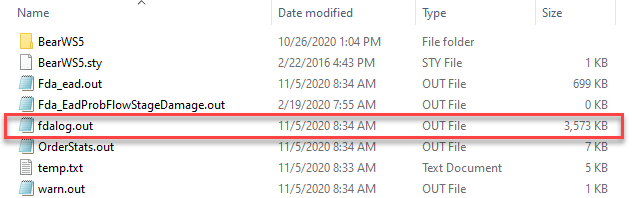
The next step is to compute stage damage with uncertainty and evaluate plans by analysis year. After evaluating plans by analysis year, a text file named fdalog.out will be created in the study directory, as can be seen below in the File Explorer Window.
Open the fdalog.out file in your preferred text file editor. There is so much information in this file! Our focus here is the distribution of the annual exceedance probabilities for Levee L3. Search for the plan, stream, year, and reach combination to which the levee of interest has been assigned. If you have a large study, consider using "Ctrl + F" and search for the most narrowly defining characteristic, probably the damage reach. The header that can be seen in the below portion of the text file matches the plan, year, stream, and reach levee assignment in the Study Levee Features Window, indicating that the information that follows that header reflects the with-project conditions construction of a 10-foot high levee.

Scroll carefully a ways down to find the Frequency Interpolated at Standard Annual Exceedance Probabilities Table. This table organizes the relative frequencies and coinciding assurance of the distribution of the annual exceedance probabilities. The annual exceedance probability is in the second column, the relative frequency is in the third column, and assurance is in the third column. Outlined in red is assurance of the 1% annual exceedance probability: there is approximately a 98.62% chance that the annual exeedance probability will be less than 0.01.
